




Digital Automation
On the other hand, encompasses the integration of robotics to reduce reliance on manual procedures through the utilization of data and software. It leverages technologies such as automatic identification and data capture (AIDC), which includes methods like mobile barcoding. The implementation of digital automation brings several benefits, including seamless integration with enterprise resource planning (ERP) systems, enhanced safety measures, heightened security protocols, and improved data management capabilities.

What is Warehouse Physical Automation?
The integration of technology in warehouse management offers the potential to minimize the need for staff to traverse different areas of the facility, leading to streamlined workflows via physical automation. Utilizing robotics for automation enhances warehouse capabilities, boosting efficiency, reliability, and scalability of operations. However, this advancement comes with its own set of challenges.
Despite the benefits, there are notable drawbacks to adopting automated systems. These include significant upfront investments, the necessity for skilled personnel to operate and maintain the technology, ongoing maintenance expenses, and equipment tailored for specific tasks.
To capitalize on the advantages of automated warehouse systems, organizations must prioritize meticulous planning and organization. Such systems are particularly well-suited for large-scale warehouses and distribution centers with sufficient space to accommodate specialized equipment.
How Warehouse Automation Functions
Warehouse automation can be categorized into two main types: physical automation and digital automation. Digital automation relies on electronics and software to streamline manual processes, thereby expanding the reach of vendors and customers. A prime example of digital automation is the utilization of warehouse management systems or automatic identification and data capture technology.

This automated transportation technology minimizes the need for human intervention, enabling rapid loading and unloading of items within the warehouse. Situated at the loading docks, these systems autonomously handle cargo transfers with minimal operator assistance, enhancing both speed and reliability in transporting products to and from the facility.
Software as a Service (SaaS) Warehouse Management: An increasingly prevalent trend in logistics is the adoption of automated warehouse management systems. Companies seeking precise control over their logistics operations often opt to digitize their activities using a Warehouse Management System (WMS) to meet evolving operational demands.
For businesses prioritizing warehouse automation, a Software as a Service (SaaS) WMS solution offers significant benefits. Cloud-based SaaS WMS solutions leverage external servers for data processing and storage, providing a cost-effective alternative to on-premises options. According to a survey by Grand View Research, companies Favor cloud-based WMS software for its affordability and ease of adoption.
Big Data Analysis in the Modern Era:A cornerstone of supply chain automation lies in its ability to generate and utilize complex information, often referred to as big data, within logistics operations. Automated warehouses yield a wealth of potentially valuable data about products, encompassing origin, destination, size, and contents.
By harnessing this data and transforming it into actionable insights, companies can optimize their supply chains and extract greater value from their facilities. Effective analysis of big data empowers informed decision-making, driving efficiency and competitiveness in the modern era of logistics.
Types of Warehouse Automation
Goods-to-Person Systems
Goods-to-person systems stand as the predominant method for alleviating congestion and maximizing efficiency in warehouse operations. Comprising carousels, conveyors, and vertical lift systems, these systems, when utilized effectively, significantly boost the speed of warehouse picking.
Lightweight products are housed within the system and automatically transported to the operator for picking, reducing walk time and ensuring precise pick and inventory data. Pairing goods-to-person systems with cutting-edge picking technologies such as artificial intelligence-powered robotics enables fully automated solutions for piece picking, easily adaptable to meet the evolving demands of businesses.
Automated Guided Vehicles (AGVs)
Also known as mobile robots, Automated Guided Vehicles (AGVs) offer unparalleled flexibility in movement, unconfined by fixed ranges. These self-contained units traverse surfaces, spaces, or lines, distinguishing them from robotic arms characterized by joints and links to a base. Nevertheless, in many instances, AGVs and robotic arms are combined, with AGVs serving as platforms for attaching robotic arms to perform versatile functions such as scanning, remote handling, and probing.
Autonomous AGVs
Autonomous AGVs represent a resilient, adaptable, and precise automation solution tailored to meet the needs of AGV producers and operators. Their key advantages lie in their flexibility and scalability, enabling seamless adaptation to varying operational requirements.
Forklift AGVs
also referred to as automated guided vehicle navigation systems within forklifts, are primarily utilized for pallet stacking at various heights. Well-suited for ground-level lifting of pallets, these systems excel in efficiently handling palletized goods within warehouse environments.
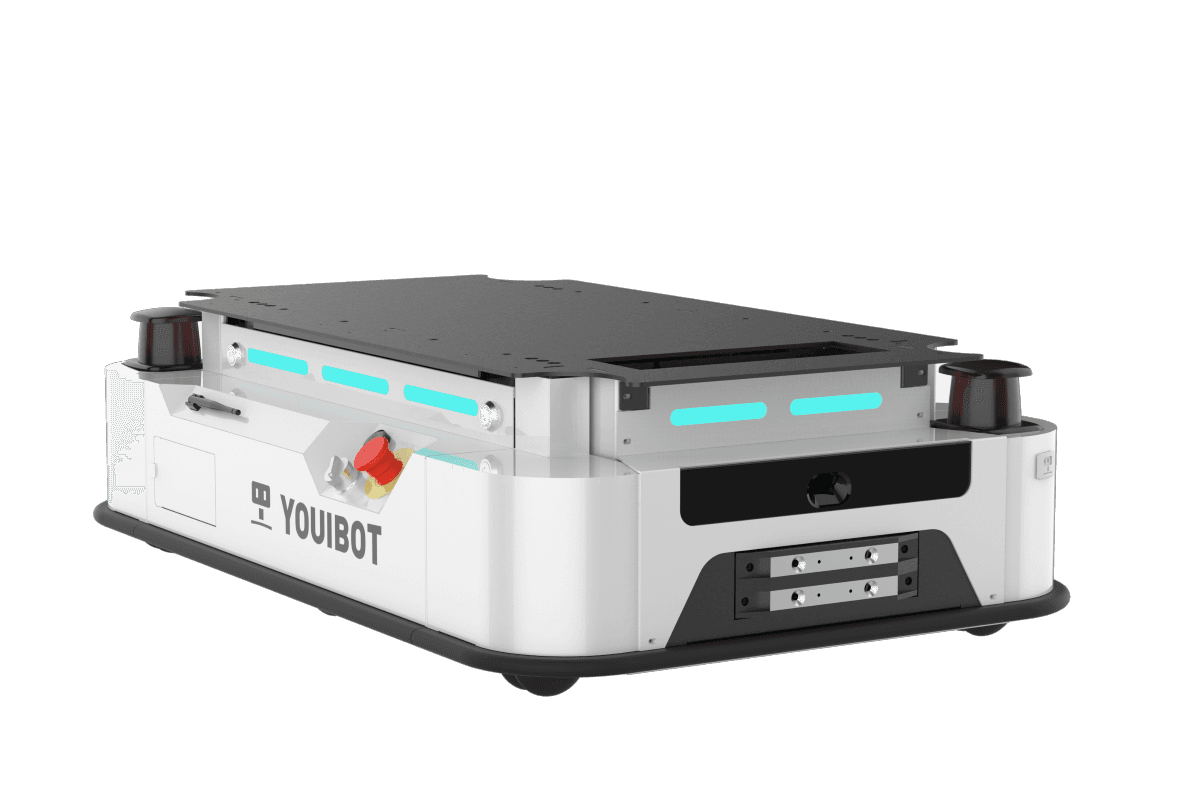
Automatic Guided Vehicles (AGVs) are unmanned load carriers designed to navigate across a facility’s floor autonomously. They are computer-controlled and typically operate on wheels, guided by software-based or sensor-based systems. AGVs ensure safe transportation of loads by following predetermined paths, executing precise acceleration and deceleration, and equipped with bumpers that detect obstacles automatically.
Underride AGVs
AGVs find widespread applications in various industries, including robotics manufacturing production lines for transporting raw materials, work-in-progress, and finished goods. They are also integral in distribution and warehousing operations for storage/retrieval support during picking processes.
Underride AGVs
Underride AGVs, also known as automated guided carts, operate by driving beneath a basket and gently lifting it for transportation to its destination without human intervention. These AGVs are commonly used in hospitals for delivering medical supplies, food, and linens.
Towing AGVs
Towing AGVs, also referred to as tagger-guided vehicles, are employed to pull trailers or carriers without drivers. They can handle multiple loads compared to underride and forklift AGVs, as they do not engage in lifting operations. However, their sole function is transportation, lacking the capability to position loads at designated locations.
Unit Load AGVs
Unit Load AGVs are specifically designed for transporting palletized or unitized goods without lifting them from the ground. Other equipment such as forklifts, conveyors, or cranes perform the lifting tasks associated with these AGVs.
Assembly AGVs
Alternatively referred to as tunneling automated guided vehicles, specialize in transporting goods to assembly points. Their maneuverability makes navigation effortless, allowing them to easily orient and fit into assembly stations.
Heavy Load AGVs
Heavy Load AGVs are predominantly utilized in industries such as steel and paper mills. They excel in transferring finished product rolls for distribution or storage. Equipped with enhanced safety features and robust construction, these AGVs ensure secure handling of heavy loads in demanding industrial environments.
Mini AGVs
Mini AGVs, also referred to as small load carriers, specialize in transporting small parts and operating in fleets or swarms. These automated guided vehicles offer exceptional flexibility and are capable of high-speed movement. Their locomotion systems are designed to ensure stability and enable maneuverability with minimal turning radius. Mini AGVs are commonly employed in selective racking systems, where they contribute to efficient material handling operations.
Autonomous Mobile Robots (AMRs):
Autonomous Mobile Robots (AMRs) operate independently, navigating without onboard human pilots. Leveraging sensors , these robots perform various tasks by comprehending and adapting to their environment. Their primary purpose is to streamline repetitive actions, such as pallet movement, freeing up operators’ time for more intricate tasks requiring greater attention. While AMRs share similarities with automated guided vehicles (AGVs), they boast distinct advantages, notably in flexibility. Unlike AGVs constrained to predetermined routes, AMRs dynamically select the most efficient paths for each task. Moreover, they are engineered to collaborate seamlessly with humans during picking and sorting activities.
The adoption of AMRs yields significant benefits:
Increased Efficiency and Productivity: By keeping operators focused and setting the pace for associates, AMRs enhance overall efficiency.
1. Reduced Labor:
AMRs minimize manual material handling through efficient navigation systems, reducing labor-intensive tasks.
2. Decreased Human Error:
Guided by clear task instructions, AMRs contribute to reduced losses and improved accuracy in material handling.
3. Enhanced Scalability:
Initial deployment of a few units can be scaled up easily to meet evolving operational demands.
Moreover, AMRs enhance workplace safety with built-in cameras and sensors, enabling collision avoidance and better environmental interpretation.
4. Robotic Arms
Robotic Arms leverage machine learning to revolutionize distribution, significantly boosting productivity. These automated picking systems are increasingly integrated into labour-constrained warehouses, driven by technological advancements. As logistics operators strive to meet escalating demands, warehouses are employing more robots capable of individual item picking. Robotic arms, controlled by sophisticated software, undertake a range of tasks including apparel and e-commerce package sorting, industrial supplies and bread packing, and electronics and consumer goods selection for order fulfilment. While technology advances, experts emphasize that robots won’t replace human jobs entirely. Nonetheless, warehouse robots continue to evolve, undertaking additional responsibilities previously performed by humans, thanks to advancements in computer vision and software capabilities.
5. Robotic Palletizers
Robotic palletizers excel in handling one or more units simultaneously and arranging them in various layer configurations on a pallet post-conveyor retrieval. These palletizing systems effortlessly accommodate diverse pallet designs and product assortments, ensuring efficient palletization operations. Moreover, palletizing and depalletizing robots can be trained to manage multiple SKU in feeds along a single line. Leveraging data from vision systems, the robot selects and positions different SKUs onto distinct pallets. With stacking patterns and requirements dictating the pace, a single robot can palletize anywhere from 8 to 30 cases per minute by selecting one product at a time. For tasks involving row picking or layer palletization, the rate can further increase.
6. Cartesian Gantry Robots
While SCARA and articulating arm robots dominate the robotics landscape, Cartesian gantry robots are gaining traction for their ability to execute large-scale tasks within confined spaces. These manufacturing robots, also known as gantry robots, find application in automation assembly and production lines, although they haven’t historically been recognized as prominently as other robot types. However, their simple design, cost-effectiveness, scalability, and diverse motor and control software options are gradually elevating their status within the robotics industry.
Benefits of Cartesian Gantry Robots:
1. Versatile movement: Capable of operating with virtually any length movement on three or more axes.
2. Scalability:Easily scalable to accommodate varying sizes and requirements.
3. Customizable gearbox and motor: Gearbox and motor sizes can be tailored to suit specific speeds and range of motion.
4. Suitable for heavy loads: Can handle a wide range of load capacities, from mild to heavy.
5. Flexibility and effectiveness:Linear axes scalability enhances flexibility and effectiveness in various applications.
6. Cost-effective: Relatively inexpensive compared to other robotic systems.
Drawbacks of Cartesian Gantry Robots:
1. Limited maneuverability around obstacles:Unable to adjust to reach into or around obstacles in their path.
2. Weatherproofing challenges: Vertical slides, belts, and rails are difficult to weatherproof, potentially impacting performance in outdoor environments.
3. Dependency on support structures:Cannot operate standalone and require stands, frames, or other mountings for stability.
Automated Storage Retrieval Systems (ASRS)
Automated Storage Retrieval Systems streamline the retrieval and storage of cargo within warehouses by automatically handling materials. These systems eliminate the need for manual intervention, enhancing operational efficiency. ASRS can be configured in various setups, utilizing vertical lift modules, carousels, shuttles, or cranes.
Benefits of Automated Storage Retrieval Systems:
1. Lower labor costs: Minimize the need for manual labor in placement and picking operations, reducing overall labor costs.
2. Increased picking accuracy: Eliminate errors associated with manual picking processes, resulting in higher accuracy levels.
Pick-to-Light and Put-to-Light Systems
Pick-to-Light and Put-to-Light Systems streamline order fulfilment processes by directing employees to specific storage locations using light-based indicators. Employees scan barcodes associated with specific orders, and light gadgets guide them to the relevant storage areas where ordered items are located. Lights on racks indicate the products available for selection to fulfil the order accurately.
Voice Picking and Tasking
Involves verbal commands to assist factory employees in fulfilling orders and tasks. Typically integrated with enterprise resource planning software or warehouse management systems, voice picking and tasking systems automatically determine order requirements as soon as an order is received. Subsequently, employees receive the message verbally through a headset. They are directed to the precise location of the item to be picked and informed about the required quantity. Employees can interact with the system to confirm locations and quantities, enhancing efficiency. Voice picking and tasking systems offer numerous benefits:
1. Improved safety: With hands-free operation, workers are less prone to accidents due to reduced distractions compared to other picking devices.
2.Enhanced picking accuracy: Elimination of distractions associated with other picking methods leads to improved accuracy.
3. Increased productivity: Workers can focus on critical tasks such as picking without interruptions to read paperwork for orders.
Automated Sortation Systems: Automated Sortation Systems streamline warehouse operations by automatically sorting materials on conveyor systems and directing them to specified locations. These systems leverage sensors, barcodes, and scanners to achieve automation. They are typically categorized into case sorters, capable of handling whole totes, and unit sorters, designed for individual items. Benefits of automated sortation systems include:
1. Faster processing:
These systems operate at higher speeds and for longer durations compared to humans, enhancing efficiency and productivity.
2. Reduced reliance on labour:
Automated sortation systems help mitigate the impact of labour shortages.
3. Improved order accuracy:
Human errors are minimized, leading to increased accuracy in order fulfilment.
Collaborative Mobile Robots Collaborative Mobile Robots are designed to work alongside human workers, aiming to minimize errors, maximize operating speeds and efficiency, and free up employees’ time for other tasks. These robots have a direct impact on efficiency and find applications in palletizing, packing, inspecting, and picking operations.












