

The Need for Automation in Agriculture
Labor Shortages: As a result of urbanization and the aging farmer population, trained labor has become increasingly scarce in agriculture. During the busiest planting and harvesting seasons, many areas experience a labor shortage, which lowers production.
Environmental Challenges: To optimize production while reducing environmental impact, farmers must be precise and efficient due to climate change, erratic weather patterns, and decreased soil fertility.
Population Growth: Without a corresponding expansion in agricultural land, the growing world population demands an increase in food production. To maximize production, this calls for creative approaches.
Economic Pressures: Farmers frequently have narrow profit margins, and crop price instability makes matters worse financially. Profitability can be increased, and operating costs can be decreased with automation.
How Robotics is Changing Agriculture
1. Autonomous Tractors and Equipment
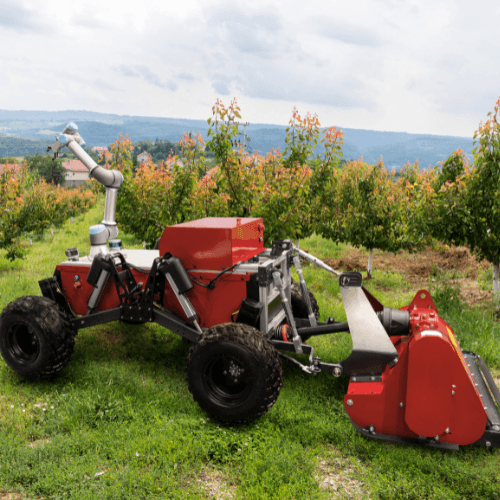
One of the most obvious uses of robotics in agriculture is the development of self-driving tractors and equipment. With the use of GPS, cameras , and sensors, these vehicles can do jobs like planting, tilling, and plowing with little assistance from humans.
Benefits
1. Lessens reliance on labor.
2. Increases the accuracy of soil preparation and planting.
3. Optimizes routes to save time and gasoline.
As an example, John Deere’s self-driving tractor employs GPS and machine learning to attain centimeter-level precision, guaranteeing ideal soil management and seed planting.
2. Monitoring and Analysis Drones
Agricultural drones with sensors and multispectral cameras are revolutionizing crop monitoring. Real-time information on pest infestations, crop health, and irrigation requirements is provided by these drones.
Uses for:
1. Field mapping to identify stressors.
2. Thermal and spectral imaging for plant health monitoring.
3. determining water-deficient areas to optimize irrigation.
For example, businesses like DJI and Precision Hawk provide drones that enable farmers to effectively survey wide areas, negating the need for labor-intensive field inspections.
3. Harvesting Robots
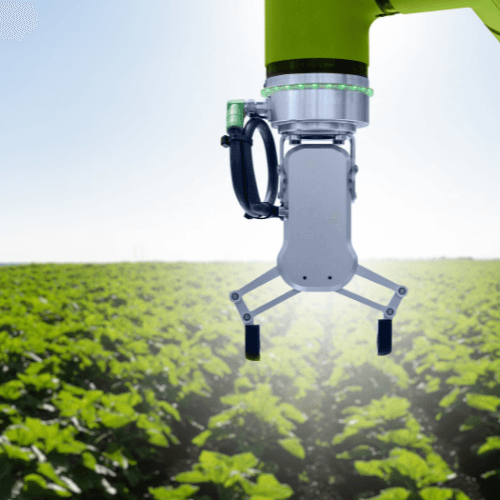
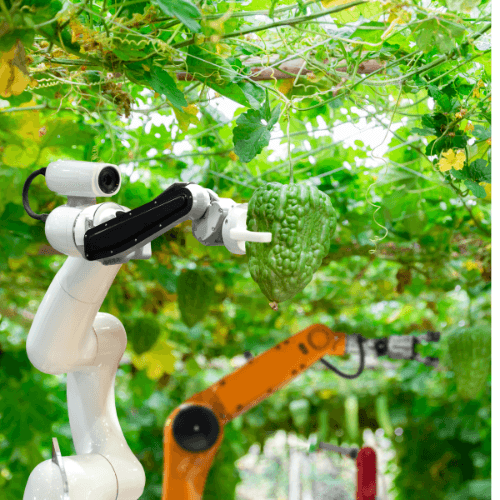
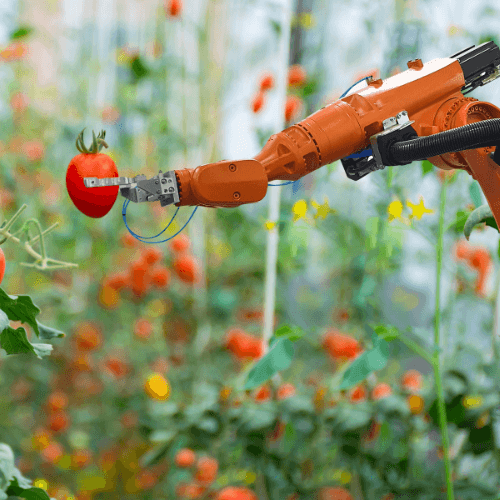
One of the most labor-intensive agricultural operations is harvesting. With the use of artificial intelligence (AI) and sophisticated vision systems, robotic harvesters can recognize ripe fruits and vegetables and select them without endangering the crops.
Benefits
1. Improves efficiency and speed.
2. Minimizes post-harvest losses brought on by postponed harvesting.
3. Continues to run even when there is a manpower shortage.
For example, Agrobot’s robotic strawberry harvester utilizes AI to assess ripeness and delicately picks strawberries with precision arms.
Because weeds compete with crops for nutrients and water, they lower crop yields, making weed control an essential part of crop management. Conventional weeding techniques are time-consuming and environmentally damaging since they use chemicals.
Robotic Solutions:
1. AI and camera-equipped robots can discriminate between weeds and crops.
2. To get rid of weeds without using chemicals, use mechanical instruments or lasers.
For example, the Ecorobotix weeding robot utilizes AI and solar power to target weeds with pesticide micro sprays, decreasing the need for chemicals by up to 90%.
Benefits of Robotics in Agriculture
1. Increased Productivity and Efficiency
In agriculture, robots can operate around the clock and complete jobs more quickly and precisely than humans. Higher crop yields, more effective resource usage, and increased productivity all result from this. Farmers may manage greater land areas by using autonomous technology to perform chores like planting, harvesting, and plowing more quickly and efficiently.
2. Lower Labor Expenses
The agriculture sector is very concerned about labor shortages, especially during busy times like planting and harvest. For repeated jobs, robotics helps lessen reliance on human workers. Farmers can reduce labor expenses and preserve operational efficiency by using fewer workers for manual labor. This is especially advantageous in areas where there is a lack of skill in agriculture labor.
With sensors and artificial intelligence, robotic systems can carry out operations with extreme precision. Autonomous tractors, for example, can improve agricultural development by ensuring that seeds are put at the proper depth and spacing. Additionally, drones and automated systems can enhance irrigation, distributing water evenly, cutting down on waste, and guaranteeing that plants receive the proper quantity. This degree of accuracy improves yields and reduces resource waste, which raises farming operations’ profitability in the long run.
4. Sustainability and the Advantages for the Environment
Robots reduce the need for fertilizer and pesticides, allowing for more environmentally friendly farming methods. Robots, for instance, may target weeds specifically while using less herbicide, which lessens the environmental effect of farming. In areas where water is limited, drones can also help optimize irrigation, ensuring that water is used effectively. Robotics contribute to more environmentally friendly farming by lowering dependency on dangerous chemicals and encouraging resource efficiency.
5. Reduced Waste and Better Food Quality
Advanced sensors and visual technologies enable robotic harvesters to recognize ripe fruits and vegetables. This accuracy lowers the possibility of crop damage while enabling the harvesting of higher-quality produce. Furthermore, products are classified according to size, quality, and freshness thanks to sorting and grading robots, which reduces spoilage during storage and transit. Food waste is decreased, and food quality is enhanced as a result.
6. Data-Informed Analytics and Decisions
Robots are able to gather enormous volumes of data from farms, giving farmers important information about crop conditions, environmental factors, and soil health. Analysis of this data can increase overall efficiency by assisting farmers in making well-informed decisions about when to sow, water, or harvest. Robotics and data analytics-powered precision agriculture can help farmers maximize crop yields while reducing waste and input expenses.
Limitations of Robotics in Agriculture
1. Complexity of Technology and Upkeep
In agriculture, robots are complex devices that need to be operated by professionals and maintained on a regular basis. To operate and maintain these systems, farmers could require specific training, and in certain rural locations, the technical assistance they want might not be easily accessible. Productivity may be impacted if a robot breaks down or malfunctions, requiring expensive maintenance and possibly delaying agricultural activities.
2. Adaptability to Some Crops Is Limited
Although robotics is quite successful in large-scale monoculture farming, it may not be as applicable to other crops or farming practices. For example, crops that need a lot of manual labor, such fragile fruits and vegetables, might not yet profit as much from automation as more resilient crops, like grains. Furthermore, small farms or farms with a variety of crops may find it more difficult to defend the expense of putting in place robotic systems made for jobs.
3. Inadequate Facilities
In distant farming locations, stable infrastructure—such as a dependable power source and internet connectivity—may not be accessible for robotic systems. Furthermore, certain systems require GPS signals to operate correctly, which can be interfered with in places with spotty satellite coverage or in difficult-to-reach places. In some places, especially in poor nations or rural locations with limited technological resources, this lack of infrastructure may make robotics less feasible.
4. Workplace Displacement Issues
Robotics’ broad use in agriculture could result in job displacement, particularly in rural areas where farming is a significant employer. Workers who may lose their jobs are worried about the social and economic effects as robots take the place of humans in duties like planting, weeding, and harvesting. Even though robotics can open new career paths in fields like data analysis, programming, and robotics maintenance, the shift may necessitate retraining programs and new employment options for displaced individuals.
5. Regulatory and Moral Difficulties
The application of robots in agriculture presents moral and legal questions, as is the case with any new technology. Drone use in farming, for instance, raises issues, especially with regard to privacy and airspace laws. Furthermore, concerns about ownership and control over farm data, as well as the moral ramifications of substituting robots for human labor, may arise from the extensive usage of robotics. To guarantee that robots is applied in agriculture in a responsible and moral manner, governments and agricultural associations will need to create rules and guidelines.
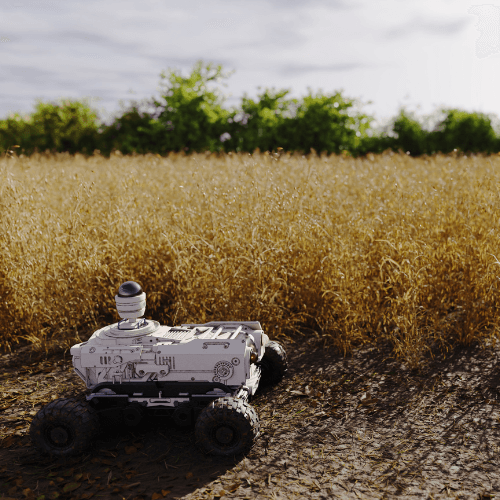
Unpredictable factors including soil variances, pest infestations, and weather fluctuations frequently affect agriculture. Even while robots’ systems are made to complete jobs precisely, they could find it difficult to adjust to quickly shifting environmental conditions. For instance, a robot can struggle to operate in muddy conditions following a lot of rain or to handle unforeseen crop illnesses. Robots are becoming more adaptive thanks to developments in AI and machine learning, but there are still issues with handling the unpredictability that comes with farming Revolutionizing Agriculture: the brands are involve Universal Robots, and DOBOT are Feeding the Future with Automation
In conclusion
From increasing farming precision to boosting sustainability and production, robotics in agriculture has revolutionary potential. Robotics is assisting farmers in meeting the rising need for food worldwide by lowering labor costs, maximizing resource use, and enhancing crop quality. But there are still a lot of obstacles to overcome before agricultural robotics can be widely used, such as high initial prices, complicated technology, and limited infrastructure. We may anticipate that robotics will become more widely available and incorporated into farming methods as technology advances. Cooperation between farmers, legislators, and technology developers will be crucial to overcoming robotics’ drawbacks and realizing it full potential. Robotics has the ability to transform agriculture and contribute to more sustainable, efficient, and ecologically friendly feeding of the world’s expanding population by tackling these issues.